Experiencing Armenian Language Through Ecosomatic Interdisciplinary Performativities
A Practice-Based Research Project, 2023
Original research developed: 2023
Published online: 2026
This practice-based research was developed in 2023 as part of my MA research. It explored how participatory performance and embodied movement can become ways of experiencing language, cultural memory, ecological relationships and empathy.
Research Questions
- Can language be learned through the body?
- How can participatory performance support language learning?
- Can embodied language practices foster cultural empathy?
- What happens when language is experienced through movement, sound and ecological relations?
Experiencing Armenian Language Through Ecosomatic Interdisciplinary Performativities
Practice-Based Research, 2023
How can participatory performance* contribute to language learning, cultural diversity, empathy and ecological awareness?
In 2023, I developed a practice-based research project exploring how language might be experienced not only through speaking, reading and writing, but also through movement, sensation, performance, cultural memory and ecological relationships.
Experiencing Armenian Language Through Ecosomatic Interdisciplinary Performativities brought together creative dance, participatory performance, embodied learning, ecosomatics and cultural memory. The research asked how interdisciplinary performance might become a space for learning, communicating and relating differently.
The research emerged from a decolonial and new materialist perspective and questioned educational approaches that position learning primarily as the transmission of knowledge. Instead, I explored learning as something that can happen through participation, bodily experience, sensory attention, interaction and relationships with human and more-than-human environments.
At the centre of the research was Western Armenian, my mother language. I chose the language both because of its relationship to my own cultural and familial history and because of its endangered status. The history of displacement and dispersion of Armenian communities has had profound effects on the transmission and contemporary development of Western Armenian. I was interested in approaching the language not only through its history of loss, but also as a living, playful and embodied language.
Language through the body
Participation was central to the research process. Participants joined rehearsals, contributed their artistic responses and later entered the performance itself. They were invited to draw, compose, communicate, dance, improvise, learn, sense and reflect.
This approach was informed by embodied cognition, which emphasises the relationship between bodily and sensorimotor experience and the ways we acquire and represent knowledge. Rather than treating the body as separate from cognitive learning, I explored how movement and sensory experience could become part of the learning process.
Performative pedagogy similarly provided a framework for understanding learning as something created collectively. Through performance, knowledge can become experiential, expressive, visual, visceral, spatial, temporal, affective and somatic.
My question was therefore not simply Can movement help someone remember a word? It was broader:
What happens when a language is encountered as a bodily, sensory, cultural and ecological experience?
Ecosomatics and the more-than-human
The research extended somatic practice towards ecosomatic relationships. Ecosomatics considers the embodied self as connected with and continuous with the embodied natural world, inviting attention not only to our own bodies but also to more-than-human bodies and environments.
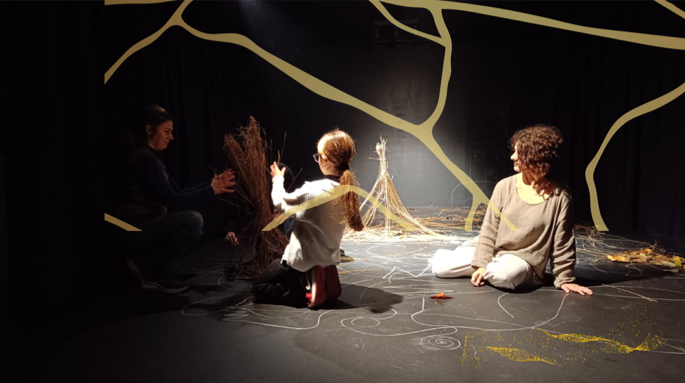
For the performance, I worked with plant materials from Dartington Estate, including flax, dried yarrow, bark, moss and branches.
Flax became particularly significant. Its movement, sound, shape and texture affected the way I experienced my own body in relation to the performance space. As I covered parts of my body with flax, I began to experience a sense of the plant and human bodies becoming intertwined.
The plants also became active elements in the participatory space. Their forms helped reshape the stage and created temporary symbolic homes. Participants interacted with the plant materials while constructing their own spaces, allowing the plants to become mediators between body, environment, memory and imagination.
The performance therefore moved beyond representing nature. I was interested in creating a situation in which the environment could become part of the learning and relational process itself.
Displacement, memory and mapping
My grandfather Stephan Babikyan’s displacement story of 1915 became another central element of the performance.
I explored words emerging from his story through my own body. I performed, sensed and responded to these words through movement and then translated my embodied responses into lines drawn with chalk on the floor.
Mapping became a way of thinking about displacement, identity and the creation of new spaces as home. Rather than reproducing a story of displacement only as loss, I explored how a new map, a new space and a new sense of belonging might be created through embodied participation.
During the performance, participants were invited to take chalk and create their own pathways on the floor. The map consequently became something collectively produced rather than something predetermined.
The audience gradually became part of the performance space. Participants walked together, paid attention to one another, sensed their pathways, made eye contact and experimented with non-verbal forms of connection.
This created a form of communal embodied listening.
Empathy and cultural connection
Participants’ responses suggested that movement and participatory performance could create connections between personal and collective memories.
After the performance, although majority words I have used during the perfomance was Western Armenian, participants abled to understand the context and wrote about their grandparents, ancestors, stories of injustice, resilience, freedom, earth, peace, home, challenge and connection. Some also connected their responses to words such as wheat and field.
These responses were significant because the research was not attempting to teach Armenian culture as a fixed body of information. Instead, it invited participants to encounter another language, history and cultural experience through their own bodies and memories.
I was particularly interested in the possibility that attending to human diversity might also affect the way we attend to the more-than-human world.
Dance as cultural transmission
Another part of the performance involved Armenian folk dance.
I worked with Armenian folk dance specialist Hagop Güleç in Istanbul to explore dances connected with plants. I selected Tzagatsori Bar, or the Valley of Flowers, and introduced the movement vocabulary and its meanings to the participants.
Rather than presenting the dance as a finished cultural form for an audience to observe, I taught the movement and eventually invited participants to dance together in a circle.
In this way, cultural knowledge was transferred through bodily participation. Dance became a way of encountering history and culture through doing, sensing and relating rather than through observation alone.
Continuing the research
This 2023 research became an important foundation for my continuing exploration of language, movement, cultural memory and embodied learning.
The questions that emerged through this project continue to inform my practice: how can language be experienced through the body? How can movement create encounters between different histories and cultures? How might embodied learning support empathy and ecological awareness? And how can performance become a space where people do not simply receive knowledge, but participate in creating it?
My ongoing work with the Armenian alphabet develops these questions further, exploring letters as visual, spatial, sonic and embodied forms and continuing my investigation into the relationship between language, movement, memory and belonging.
The 2023 project therefore remains an important point of departure in my practice-based research: an attempt to bring language learning, dance, cultural memory and ecological awareness into the same experiential space.
Original research developed in 2023.
A longer 2,000-word version of the research text, including references and further documentation of the performance, is available upon request for academic, research and collaborative purposes.
* The details and the link of the performance trailer video can be found in bellow