Tag: immigration

  • On the Threshold: Visibility, Labor, and Belonging

    On the Threshold: Visibility, Labor, and Belonging

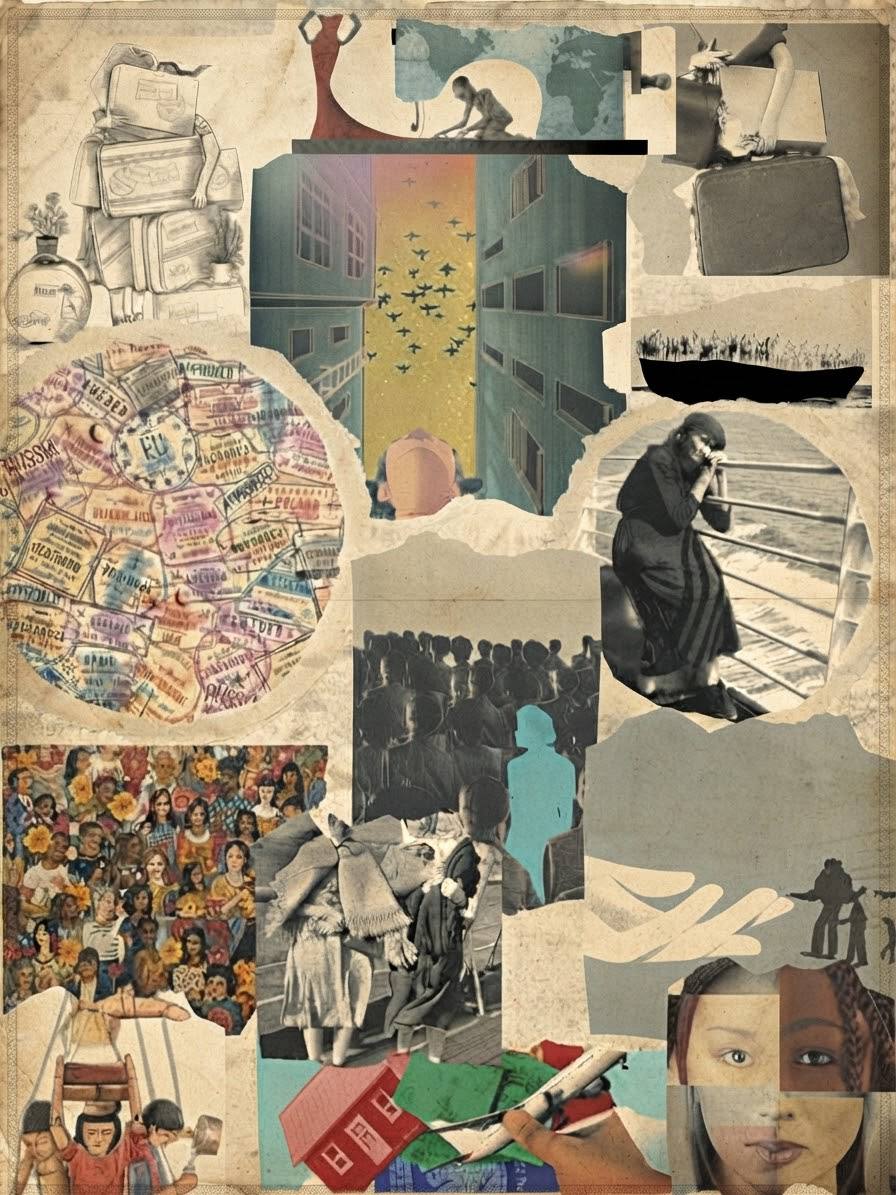
    From the moment human beings fall into the womb, they find themselves wrapped in a web of both visible and invisible networks. Their relationships—familial, social, and professional—along with their connections to the land they inhabit, non-human living beings, and ultimately the universe, are shaped within inherited and ever-changing social, economic, ecological, political, and cultural dynamics. Migration, on the other hand, marks the beginning of a new story that completely transforms these networks of relationships through spatial displacement. In this article, I look from the perspective of intersectional feminism at how visibility, labor, and belonging are shaped for different individuals within this network of changing relationships brought on by migration, and how various inequalities intersect.

    In the process of transforming a new location into a permanent or temporary second home through migration, a person leaves behind their circle of friends, family members, social habits—in short, the ecosystem they are accustomed to—to a large extent. In today’s world, the first element that greets migrants in their new country is bureaucracy. Certain skills you have developed over the years in your homeland can suddenly become useless. For example, you might be someone who is social, quick to resolve issues, and accustomed to working and progressing by producing despite most difficulties and impossibilities; yet bureaucracy demands that you wait, and during this process, prove with various documents that you are a socially and economically acceptable subject.

    In my own story, I encountered bureaucracy and slow-moving structures just as I realized I had to rebuild my career from scratch in the middle of a void—as an independent artist and educator in the English countryside, where only a handful of people were aware of my work, and where relationships were as distant as the living spaces themselves. Over time, I realized that I needed to keep my pace, style, and goals open to change, and to enhance my ability to adapt. Although most of the professional and structural problems I had to deal with in Turkey vanished here, the decrease in the intensity of feelings such as closeness and belonging began to make me feel that something was amiss.

    I paused and tried for a while to make sense of this emerging complexity within English village life, which has very low cultural diversity; I did not know where to start untangling this knotted ball of yarn. Eventually, I decided to snap out of my state of inaction and continue doing the things I knew best and that made me feel good. With the arrival of spring, acceptance letters began to arrive from various festivals I had applied to. This was a cause for celebration! However, while working on the details of the workshops I had designed, I found myself in the middle of a continuous stream of email correspondence spanning months—something I had never experienced before. I spent my days reading and responding one by one to emails for the festivals I was accepted into: risk assessments for workshop participants, sensory risk maps, and files to create additional promotional visuals to support workshop publicity—requests I was not used to being asked for in Turkey. As my body rebelled against the process, I fundamentally realized that I had to meet bureaucratic expectations at this point as well.

    During those days, alongside my new experiences in the triangle of artistry, instruction, and labor in the UK, I also recalled my experiences in Turkey. While some arts and culture organizations that expect flawless service from you can duly compensate artists and educators for their labor and time, others cannot—or choose not to—meet this obligation financially or morally. Although offers for unpaid work are less common in the UK, the country where the playbook of capitalism was written, offering unpaid work or proposing compensation far below market value in exchange for “visibility and recognition” is extremely widespread, especially in the art sectors of developing countries. When this exploitation of labor—handsomely packaged and served to you—comes from individuals in positions of power, it is not easy for young or unemployed artists to say “no.” We also frequently hear of individuals who demand their rights being bullied and ostracized by these very same powerful figures and institutions under the accusation of “putting money ahead of art.” Consider a sector that marginalizes you when you demand a fair living wage for your labor, while the exact same individuals or institutions share their demands for the right to life, gender equality, nature conservation, justice, and the like with society through both their rhetoric and events, thereby preserving their relatively privileged and enlightened status. So, what makes this contradiction possible and persistent? The permission granted by the relevant administrations to all of this, and the silent majorities who do not know their rights and do not demand them…

    Meanwhile, the bureaucratic structure uses intermediary actors—both in the context of management and public relations—who polish and present events in order to create the illusion that things are running smoothly, to render existing injustices invisible, and to convince everyone that everything is fine. French sociologist and philosopher Pierre Bourdieu, who researched how systems of culture, power, class, and education reproduce inequalities in society, viewed art as a contentious battlefield and spoke of an elite group called “gatekeepers” who decide who ascends in the art world and how. These gatekeepers—who deliberately ignore the labor of some, surprisingly give others their full due, continue to exploit the labor of others in the background, and stall a segment of artists with the myth of “if you are good enough”—hold fixed positions spanning many years in the same or similar institutions. However, they are losing their power compared to the past, thanks to a new culture of seeking rights, exposure, transparency, and solidarity.

    Yet the world is in a transition period; even if slow, the system is transforming, and everyone’s choices matter. Are we standing in solidarity with traditional spaces that enjoy regular structural support, refuse to confront their past, and are unwilling to give up their role as kingmakers behind a rhetoric of solidarity? Or are we supporting disadvantaged, alternative institutions and artists who cannot receive the support they deserve from the system for their labor and are rendered invisible?

    And more importantly, how can we liberate ourselves from the philosophy of a system that governs us by dividing us, and move forward without falling into the discrimination of “one or the other”? I believe we can re-examine these questions in the light of intersectional feminism, a term brought into the literature by law professor Kimberlé Crenshaw. This approach advocates for a fair, pluralistic, and diverse life practice not just for a specific group, but for everyone—placing at its center the unique disadvantages brought about not only by being biologically a “woman,” but also by belonging to a different race or ethnicity, having a different sexual orientation, or being a migrant. In this context, the centralized, non-transparent, and discriminatory bureaucratic structures I exemplified above cannot serve intersectional feminist ecosystems. In the arts and culture environment, however, curatorial choices can reflect the values of intersectional feminism; to give an example, despite all their bureaucratic weight, the festivals I participated in with my workshops this spring truly possessed inclusivity and diversity.

    As I conclude my writing, I would like to remind us that whose voices we hear today and whose creations we see—or fail to hear and see—continue to shape not only their lives, but also our own lives, dreams, and intellectual worlds.

    *This writing has been published on October 8th, 2026 at Agos Weekly Newspaper in Parhessiapar collum
  • MA Thesis

    MA Thesis

    Experiencing Armenian Language Through Ecosomatic Interdisciplinary Performativities
    A Practice-Based Research Project, 2023

    Original research developed: 2023
    Published online: 2026

    This practice-based research was developed in 2023 as part of my MA research. It explored how participatory performance and embodied movement can become ways of experiencing language, cultural memory, ecological relationships and empathy.

    Research Questions

    • Can language be learned through the body?
    • How can participatory performance support language learning?
    • Can embodied language practices foster cultural empathy?
    • What happens when language is experienced through movement, sound and ecological relations?

    Experiencing Armenian Language Through Ecosomatic Interdisciplinary Performativities

    Practice-Based Research, 2023

    How can participatory performance* contribute to language learning, cultural diversity, empathy and ecological awareness?

    In 2023, I developed a practice-based research project exploring how language might be experienced not only through speaking, reading and writing, but also through movement, sensation, performance, cultural memory and ecological relationships.

    Experiencing Armenian Language Through Ecosomatic Interdisciplinary Performativities brought together creative dance, participatory performance, embodied learning, ecosomatics and cultural memory. The research asked how interdisciplinary performance might become a space for learning, communicating and relating differently.

    The research emerged from a decolonial and new materialist perspective and questioned educational approaches that position learning primarily as the transmission of knowledge. Instead, I explored learning as something that can happen through participation, bodily experience, sensory attention, interaction and relationships with human and more-than-human environments.

    At the centre of the research was Western Armenian, my mother language. I chose the language both because of its relationship to my own cultural and familial history and because of its endangered status. The history of displacement and dispersion of Armenian communities has had profound effects on the transmission and contemporary development of Western Armenian. I was interested in approaching the language not only through its history of loss, but also as a living, playful and embodied language.

    Language through the body

    Participation was central to the research process. Participants joined rehearsals, contributed their artistic responses and later entered the performance itself. They were invited to draw, compose, communicate, dance, improvise, learn, sense and reflect.

    This approach was informed by embodied cognition, which emphasises the relationship between bodily and sensorimotor experience and the ways we acquire and represent knowledge. Rather than treating the body as separate from cognitive learning, I explored how movement and sensory experience could become part of the learning process.

    Performative pedagogy similarly provided a framework for understanding learning as something created collectively. Through performance, knowledge can become experiential, expressive, visual, visceral, spatial, temporal, affective and somatic.

    My question was therefore not simply Can movement help someone remember a word? It was broader:

    What happens when a language is encountered as a bodily, sensory, cultural and ecological experience?

    Ecosomatics and the more-than-human

    The research extended somatic practice towards ecosomatic relationships. Ecosomatics considers the embodied self as connected with and continuous with the embodied natural world, inviting attention not only to our own bodies but also to more-than-human bodies and environments.

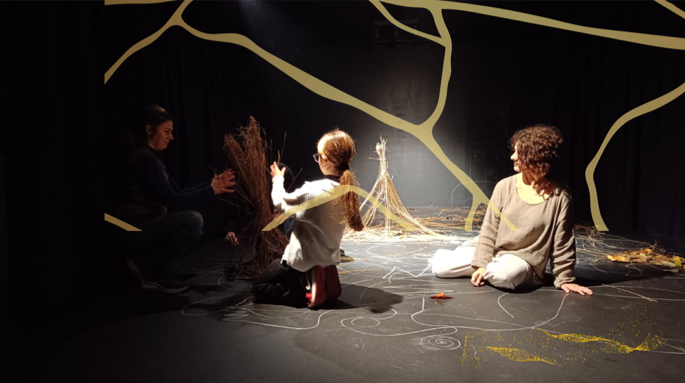
    For the performance, I worked with plant materials from Dartington Estate, including flax, dried yarrow, bark, moss and branches.

    Flax became particularly significant. Its movement, sound, shape and texture affected the way I experienced my own body in relation to the performance space. As I covered parts of my body with flax, I began to experience a sense of the plant and human bodies becoming intertwined.

    The plants also became active elements in the participatory space. Their forms helped reshape the stage and created temporary symbolic homes. Participants interacted with the plant materials while constructing their own spaces, allowing the plants to become mediators between body, environment, memory and imagination.

    The performance therefore moved beyond representing nature. I was interested in creating a situation in which the environment could become part of the learning and relational process itself.

    Displacement, memory and mapping

    My grandfather Stephan Babikyan’s displacement story of 1915 became another central element of the performance.

    I explored words emerging from his story through my own body. I performed, sensed and responded to these words through movement and then translated my embodied responses into lines drawn with chalk on the floor.

    Mapping became a way of thinking about displacement, identity and the creation of new spaces as home. Rather than reproducing a story of displacement only as loss, I explored how a new map, a new space and a new sense of belonging might be created through embodied participation.

    During the performance, participants were invited to take chalk and create their own pathways on the floor. The map consequently became something collectively produced rather than something predetermined.

    The audience gradually became part of the performance space. Participants walked together, paid attention to one another, sensed their pathways, made eye contact and experimented with non-verbal forms of connection.

    This created a form of communal embodied listening.

    Empathy and cultural connection

    Participants’ responses suggested that movement and participatory performance could create connections between personal and collective memories.

    After the performance, although majority words I have used during the perfomance was Western Armenian, participants abled to understand the context and wrote about their grandparents, ancestors, stories of injustice, resilience, freedom, earth, peace, home, challenge and connection. Some also connected their responses to words such as wheat and field.

    These responses were significant because the research was not attempting to teach Armenian culture as a fixed body of information. Instead, it invited participants to encounter another language, history and cultural experience through their own bodies and memories.

    I was particularly interested in the possibility that attending to human diversity might also affect the way we attend to the more-than-human world.

    Dance as cultural transmission

    Another part of the performance involved Armenian folk dance.

    I worked with Armenian folk dance specialist Hagop Güleç in Istanbul to explore dances connected with plants. I selected Tzagatsori Bar, or the Valley of Flowers, and introduced the movement vocabulary and its meanings to the participants.

    Rather than presenting the dance as a finished cultural form for an audience to observe, I taught the movement and eventually invited participants to dance together in a circle.

    In this way, cultural knowledge was transferred through bodily participation. Dance became a way of encountering history and culture through doing, sensing and relating rather than through observation alone.

    Continuing the research

    This 2023 research became an important foundation for my continuing exploration of language, movement, cultural memory and embodied learning.

    The questions that emerged through this project continue to inform my practice: how can language be experienced through the body? How can movement create encounters between different histories and cultures? How might embodied learning support empathy and ecological awareness? And how can performance become a space where people do not simply receive knowledge, but participate in creating it?

    My ongoing work with the Armenian alphabet develops these questions further, exploring letters as visual, spatial, sonic and embodied forms and continuing my investigation into the relationship between language, movement, memory and belonging.

    The 2023 project therefore remains an important point of departure in my practice-based research: an attempt to bring language learning, dance, cultural memory and ecological awareness into the same experiential space.

    Original research developed in 2023.

    A longer 2,000-word version of the research text, including references and further documentation of the performance, is available upon request for academic, research and collaborative purposes.

    * The details and the link of the performance trailer video can be found in bellow