On a May day, while enjoying the sense of emptiness after a long period of intense academic research and thesis writing, a tickle of curiosity led me to type some of the keywords I had explored in my thesis—such as Armenian, dance, alphabet, and embodied learning—into a search engine, eager to discover academic researchers with similar interests and their work.
Among the results, the name Nilüfer Gros immediately caught my attention. First, I read her article Carrying the Nest: Rewriting History through Embodied Research. Then I watched her performance Enterrer La Robe – Burying the Dress, which she created for her doctoral research at the Paris State Conservatory, broadcast live from Paris. The performance is still available to watch on YouTube.
In the dry and silent atmosphere of the independent dance scene in Turkey—already in decline since 2010—I had long stopped watching local works that are rarely staged, often apolitical, distanced from any quest for a new movement language, or part of over-sponsored art festival programs that mimic Western canon with exorbitant ticket prices. While elitist art often privileges those approved by the authorities of the field at a given time and context, contemporary dance in Turkey still lacks an accessible, sustainable, diverse, and inclusive policy, preventing it from reaching the general public. This is the outcome of a homogenizing, discriminatory, and denialist practice perpetuated by those in power, producing its own monologue across all levels of the cultural mainstream.
Within this long-normalized environment, which has been unable to produce its own critique, watching Burying the Dress felt like a true breath of air. The work tells stories of violence endured by women of different identities and ages—especially those from the eastern regions of the country—from 1915 to the present, in a multilayered manner that also reveals recurring patterns in this chain of violence. The text, co-written by Nilüfer Gros and Nejbir Erkol, is performed in Turkish with French supertitles.
The staging itself makes a statement: rather than using a flat wall or center stage, the performance takes place in a corner of the space, with the performer situated at the intersection. This choice inevitably invites the audience to focus on the urgency of the narrative, drawing them into a narrowing corridor of stories long kept in the dark.
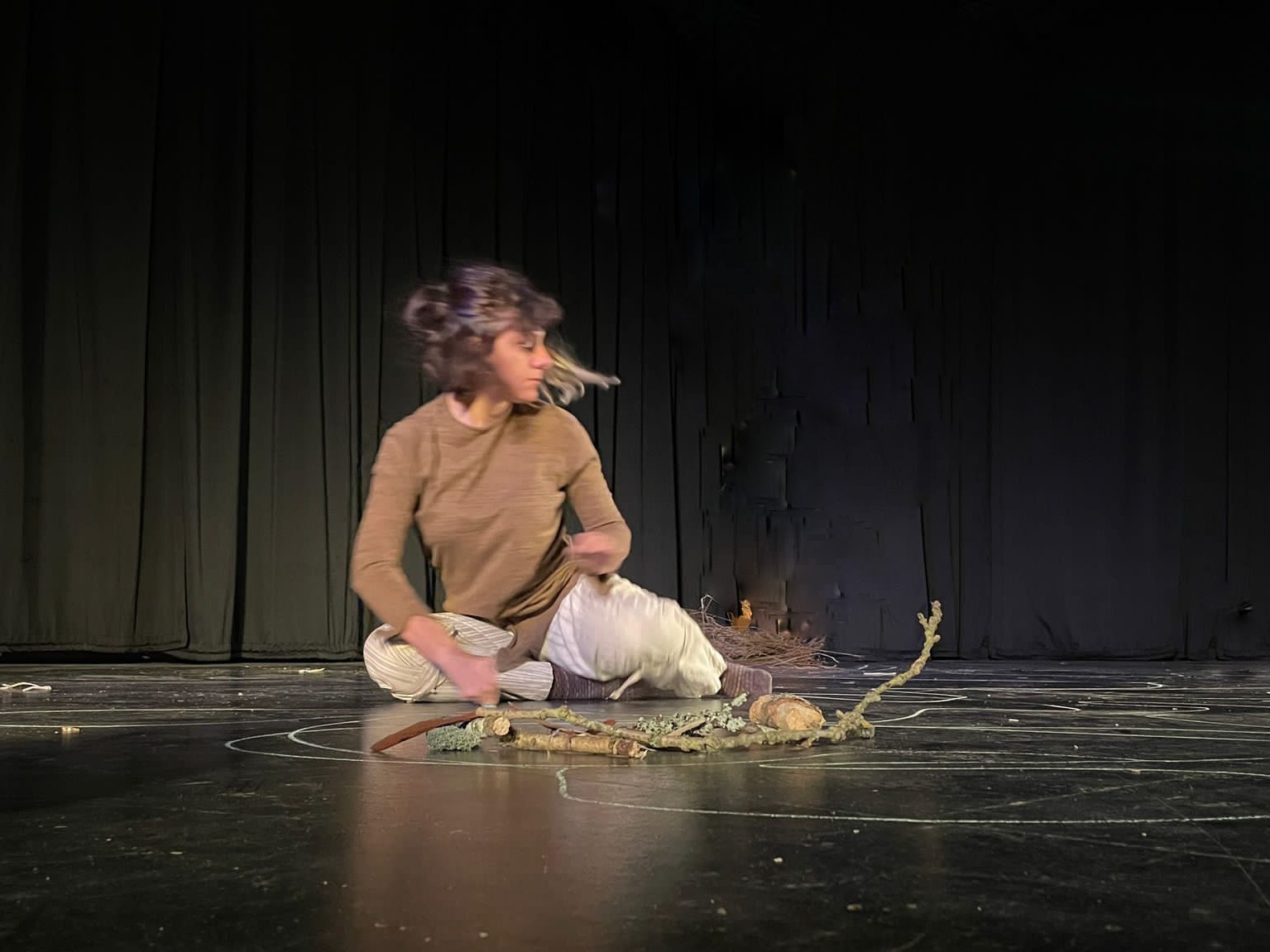
On stage is a silent woman, very pure; behind her lies a pile of soil. As she intermittently connects with this soil at various moments, I wonder: is she digging her own grave? Searching for someone? Unearthing a victim of exile, an accident, or a woman who died during an attack in her village? Gros began hearing these stories while working at a state university in Mardin. Over the years, as she traced the stories of these women, they began to turn into ghosts in her life—appearing beyond time and geography, even after she moved to another country. In its emotional intensity, the work becomes a ritual of mourning, confrontation, and ultimately, healing—for women who long to be free of their bodies, for those whose existence or disappearance most of us are unaware of. Is the soil applied to the face a gesture of purification? Or does it signify the traces left by violence on a woman’s soul and body, passed on through generations? I’m not sure which is more clearly reflected, but watching it feels good—it compels me to return to this web of meaning time and again. Every woman in this story feels familiar. As the stories unfold—through words, voice, and sometimes silent bodily movements—it’s as if they take wing. Despite their weight, they bring a sense of relief.
While watching, I drift into my own bodily-kinesthetic memory… I remembered the soil brought from Malatya—Hrant Dink’s hometown—during his funeral. Soil is our homeland, our belonging, the space where we feel safe, rooted, nourished, and nurtured. But, as shown in this piece, it can also have other meanings. Like when my grandfather, five years old in Erbaa, Tokat, in 1915, was dressed as a girl by the elders of his family and had his face nearly covered with soil to prevent him from being taken away.
Nilüfer presents a transparent body on stage—one not crushed under the weight of all these stories. With deep awareness, she mediates the displacement stories of Armenian, Kurdish, Assyrian, Yazidi, Turkish, and Jewish women, making them visible and heard. The first time we hear her real voice is when she sings a lament composed by Virginia Kerovpyan’s grandmother, Arshaluys, during her exile.
It’s hard to even applaud when the performance ends. I’m overwhelmed by both the pleasure of witnessing a sincere, well-crafted piece and the conflicting shock of having these painful stories strike my flesh. While my heart celebrates this encounter with the words, “What a wonderful, wonderful performance!” I also wish that the pain held in every family could find its own voice, its own words, its own expression—without seeking approval or understanding. And I remember James Baldwin’s words:
“Not everything that is faced can be changed, but nothing can be changed until it is faced.”
This article published on Agos Newspaper, in Turkish https://www.agos.com.tr/tr/yazi/26464/ermeni-alfabesi-ile-dans
This article published on Agos Newspaper in Turkish https://www.agos.com.tr/tr/yazi/29092/toprakla-bulusan-hayalet-bedenler